Exhibition: Core Samples
March 12 – June 30, 2026
Core Samples: An exhibition organized by Samaa Elimam and Michael Osman
The second program in our AUD60 Celebration
Perloff Hall, Room 1118
On view March 12 through June 30, 2026 by appointment only
Please contact us to arrange a viewing
“Core Samples” uncovers decades of materials from AUD’s archives, an assemblage that highlights the volume and heterogeneity of media used to record design work over the sixty years of pedagogy at Perloff Hall. Check out our photo gallery from the exhibition's March 12 opening reception.
The exhibition raises various questions: What has been kept, and what has been lost? How does an institution look at itself to generate an impression of its own history? How can the current generation of faculty and students solicit others to engage in the process of preserving the institution’s history? How can our interest in unpacking the archive appeal to values of both beauty and objectivity? In our selection of “samples,” can we avoid the biases of our own time? How can the exhibit allow Perloff Hall’s current population to connect with previous generations who worked and learned there?
“Core Samples” seeks a broad view of our history that avoids selecting the greatest hits from the past. The curatorial strategy follows directly from its title: much like a soil sample that reveals the strata of a site before a building is built, we sample from an overwhelming accumulation of media to examine the interwoven cultures of architecture and urban design at UCLA.
The media on view, in their diverse recording technologies, serve also as evidence of the multigenerational nature of the institution and its self-regard. The exhibition is in fact determined by the various material infrastructures that serve to contain a collective memory. Inspired in part by the spirit of the family album, these media invite alumni, faculty, and the larger community to recall the intersection of lives lived at AUD.
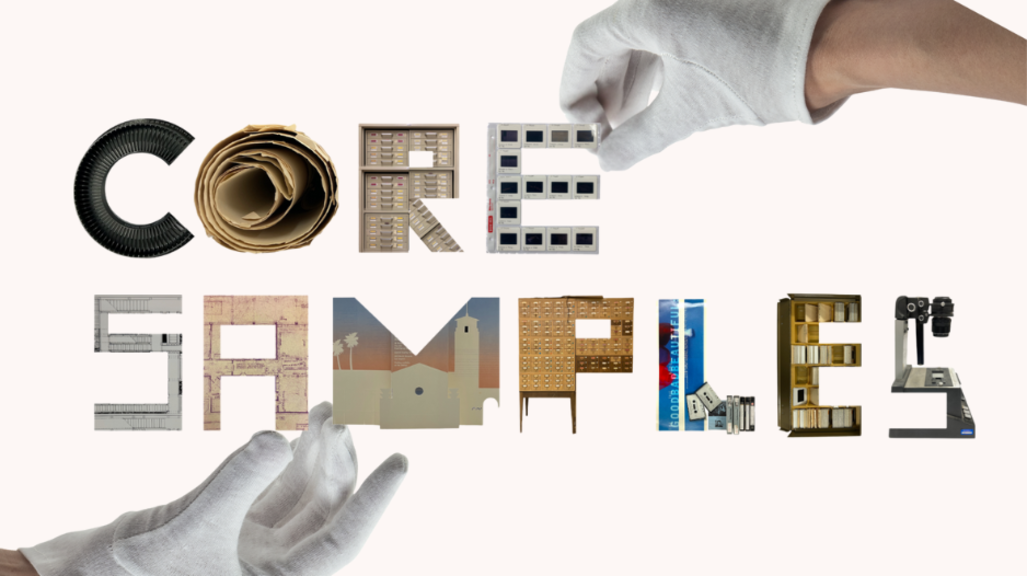
To focus on the methods of storage that secure and preserve the heritage of our institution purposely foregrounds formats that constitute a place. It is an inventory of ideas and visions recorded in cassette tapes, slides, posters, photos, and videos.
“Core Samples” will initiate the transformation of the archive into a teaching collection. The exhibition vacillates between a display and a classroom to reactivate stored materials during and after the opening. It suggests a future for research and pedagogy based in the archival collection: it is, after all, an archive of teaching and learning that projects many visions of the future. The display will enact “a seminar in progress” to invite collaboration and encourage an open-ended form of sociability for viewing and discussing the archive.
"Core Samples" is open for viewing by appointment only. Please email AUDOffice@aud.ucla.edu to arrange. We are pleased to offer viewings visits between 9 am and 5 pm most weekdays.